Will software engineers disappear? Take a look at an old drafting room
Technical drawings used to be produced by entire halls full of people. Today a fraction of them does the same work, and yet the profession has not vanished. Why I think software engineers face a transformation rather than an ending.
Almost every week I read that AI will soon replace programmers. Sometimes from people who sell AI, sometimes from people who are afraid of it. Whenever I think about it, one old photograph keeps coming back to me.
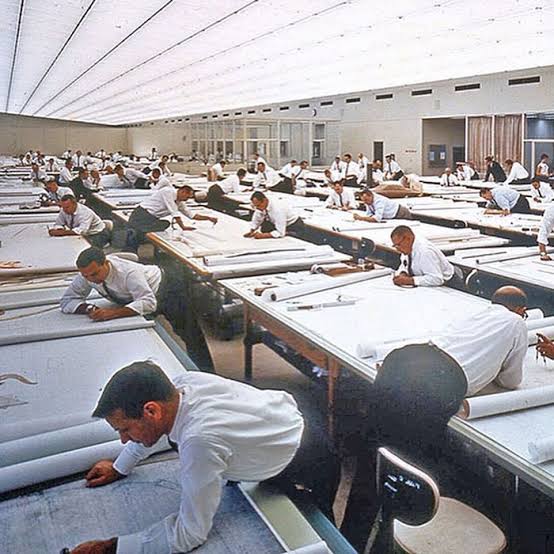
The drafting room disappeared, the drafter stayed
Before CAD, every technical drawing was made by hand. Every line, every dimension, every correction. When the brief changed, the drawing was redrawn. That is why car makers and aircraft plants had entire halls full of drafting tables.
In the 1980s and 1990s, computers and CAD arrived. Work that used to need a hall is now handled by a few people at their screens. And yet the profession did not disappear. In 2025 the US Bureau of Labor Statistics (BLS) still counts about 180,000 drafters and expects roughly the same number in 2035. As the reason why their numbers are not growing, it names CAD and BIM: they raise productivity and let engineers and architects do much of the work themselves.
So the drafter did not die out. The job changed. Instead of drawing lines, drafters model, check and coordinate. And more drawings are produced than ever, just by fewer hands.
What people in the field say
Opinions differ a lot, so here are just a few voices I find important.
Dario Amodei (Anthropic) said in Davos in January 2026 that within six to twelve months AI models could do "most, maybe all" of what software engineers do today. He also mentioned that some of his engineers no longer write code themselves, they only edit what the model produces. At the same time he admitted he is not sure how fast it will happen.
Grady Booch, one of the fathers of UML and now IBM's Chief Scientist for Software Engineering, sees it the opposite way in a February 2026 episode of The Pragmatic Engineer podcast. In his view, a "third golden age of software engineering" is beginning. Programmers feared for their jobs when compilers and higher-level languages arrived too, and AI is just another layer of abstraction. His summary: your tools are changing, but your problems are not.
And the data? In 2025 the BLS counts more than 1.7 million software developers and expects their number to grow by 10% by 2035. A Stanford study (Brynjolfsson et al., 2025) so far mainly sees one thing: in the occupations most exposed to AI, developers among them, employment of people aged 22 to 25 fell by about 13%, while for more experienced colleagues in the same occupations it held steady or kept growing.
What I think
AI writes a large part of my code today. But what it writes, I first had to think through, explain, check, and then take responsibility for. Just like with the bakery taking orders over WhatsApp: the AI translates, a human decides.
What I think is disappearing is turning a clear brief into code. Forms, CRUD, repeated patterns. Exactly the things juniors used to learn on. And that is the uncomfortable part: if the work people started on disappears, where will future seniors come from? Drafters had to solve this too. The way into the field changed, it did not close.
Everything around it, on the other hand, is gaining value. Understanding what the client really needs. Designing a system that lasts. Spotting when the AI generated nonsense that only looks good. Security, testing, operations. And communicating with people who do not want to know anything about software.
On top of that, when software gets cheaper, more of it gets made. A small bakery could not have afforded a custom system before; today it is an ordinary project. There will be more and more projects like that, and someone has to design and build them so that they work.
Conclusion
The drawing board disappeared. The drafter stayed, just doing different work, with fewer of them per drawing. I think software will go a similar way. A programmer who only turns briefs into code really is in trouble. An engineer who understands the problem, the system and the people it all revolves around will still be needed. Maybe even more than today.
Sources
- BLS: Drafters (Occupational Outlook Handbook)
- BLS: Software Developers, Quality Assurance Analysts, and Testers
- Entrepreneur: Anthropic CEO Says AI Could Replace Software Engineers in 6 to 12 Months
- The Pragmatic Engineer: The third golden age of software engineering – thanks to AI, with Grady Booch
- Stanford Digital Economy Lab: Canaries in the Coal Mine? Six Facts about the Recent Employment Effects of AI